Overview

In California, most new parents have the right to job-protected leave from work with pay. This page explains leave and pay rights for parents and other close family members who need extended time off work to care for children with serious health conditions, including preterm infants in the neonatal intensive care unit (NICU). These rights are available regardless of immigration status.

Steps for Parents

  1. Talk to your or your child’s health care provider to see what leave you need from work.
  2. Tell your employer you need leave and give them a note from your or your child’s health care provider. No medical note is needed for leave to bond with a baby. If your expected return date or need for leave changes, update them.
  3. Apply to the Employment Development Department (EDD) for partial pay during your leave (Paid Family Leave (PFL) or State Disability Insurance (SDI)).
  4. If you have questions or run into problems, call Legal Aid at Work (800-880-8047) for free, confidential advice in multiple languages.


Leave During and After Pregnancy

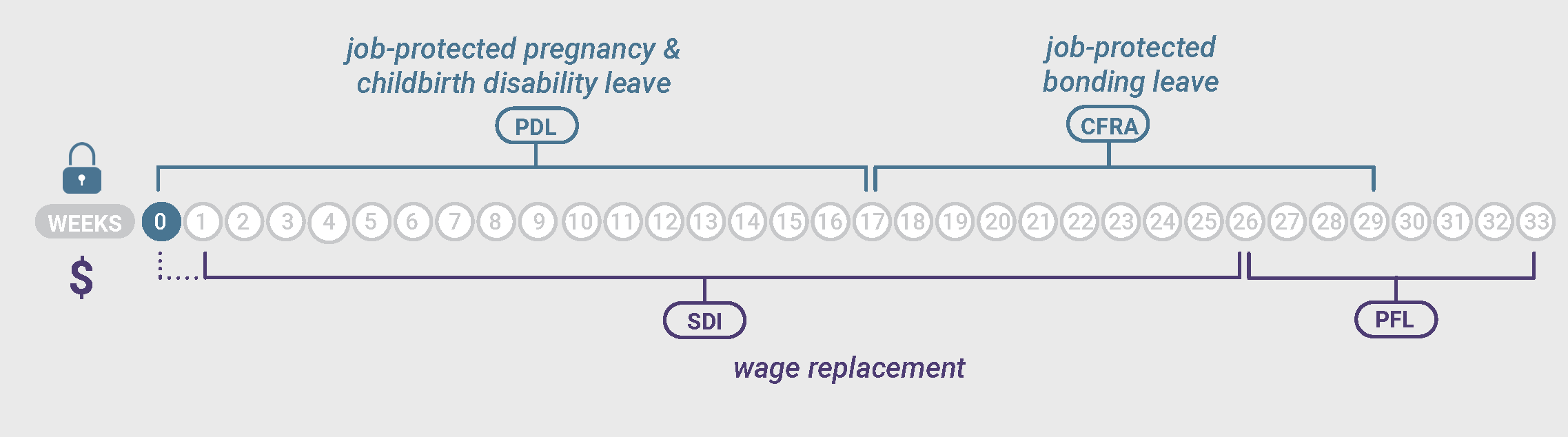
Parents who give birth may have the right to job-protected leave from work for their own health. Pregnancy Disability Leave (PDL) provides up to 4 months of unpaid, job-protected time off work before and after delivery while you are unable to work because of your health. You are eligible for PDL if your employer has 5+ employees. While you take leave, you may be able to receive partial pay through State Disability Insurance. Apply at EDD.ca.gov

Caregiving and Bonding After Delivery

All parents and other family members may have the right to take job-protected leave from work to bond with a child or care for a child in the Neonatal Intensive Care Unit (NICU). The California Family Rights Act (CFRA) provides 12 weeks of unpaid, job-protected time off work for parents to bond with a new child or for close family members (including parents, grandparents, siblings or a person who is like family, even if they are not legally or biologically related) to care for a seriously ill child. You are eligible if your employer has 5+ employees, you have worked for your employer for 12+ months, and you have worked 1250+ hours for your employer in the last 12 months. That’s about 25 hours per week. 

Caregiving or bonding leave is in addition to and separate from Pregnancy Disability Leave. 

Leave to care for a seriously ill child can be taken for whole days or weeks at a time or just an hour or two if the child’s healthcare provider says it is necessary. It can also be a reduced work schedule. Many parents take leave for a few hours on multiple days to match their child’s scheduled treatment or appointments or to breastfeed their child in the NICU. If you take leave from work to care for a loved one, you may be able to receive partial pay through Paid Family Leave. Apply at EDD.ca.gov

Frequently Asked Questions

How can I access job-protected leave from work?

Talk with your health care provider or your child’s health care provider about how long you need to be off work for your health or to care for your child. Follow your employer’s usual procedure for requesting time off. If you speak in person or over the phone, follow up with an email, text, or letter to confirm your conversation, and keep a copy. Give your employer at least 30 days’ notice of your leave, if possible. In cases of emergency, tell your employer as soon as you can.

Can I receive pay while I am out on leave?

State Disability Insurance (SDI) provides up to 60 or 70%* of your wages after a one-week waiting period for up to 52 weeks while you are unable to work because of your own health. This includes pregnancy related health conditions. Paid Family Leave (PFL) provides up to 60 or 70%* of your wages for up to 8 weeks while you are unable to work because you are bonding with a new child or caring for a seriously ill family member (including a child, sibling, or grandchild). You can apply for SDI and PFL online through the EDD’s website at EDD.ca.gov. You can also ask your employer about paid sick days, paid time off, or vacation. For information on how to apply for SDI or PFL if you are undocumented, see Undocumented Workers’ Guide to Applying for California Disability and Paid Family Leave at legalaidatwork.org/wf

* Starting in January 2025, SDI and PFL benefit rates will increase to 90% for most workers.

Will I have access to health insurance while I am out on leave?

Workers who qualify for PDL or CFRA are entitled to continued health insurance benefits during leave. You may need to pay your usual portion of the premium. An employer cannot take away your health benefits because you use leave to reduce your schedule from full-time to part-time.

My employer is not allowing me to take leave or is retaliating against me for taking leave. What can I do?

If your employer won’t let you take legally-protected leave, punishes you, or treats you worse than other employees because of your leave, you can file a claim with the California Civil Rights Department. Call Legal Aid at Work at 800-880-8047 for free legal assistance.

I need to express milk at work. What can I do?

You have the right to express milk at work in a safe and private place. For more information on your lactation rights at work, call Legal Aid at Work at 800-880-8047 or check out the lactation factsheet at legalaidatwork.org/wf


Sample Timelines: Typical and Complicated Pregnancy

Typical Pregnancy

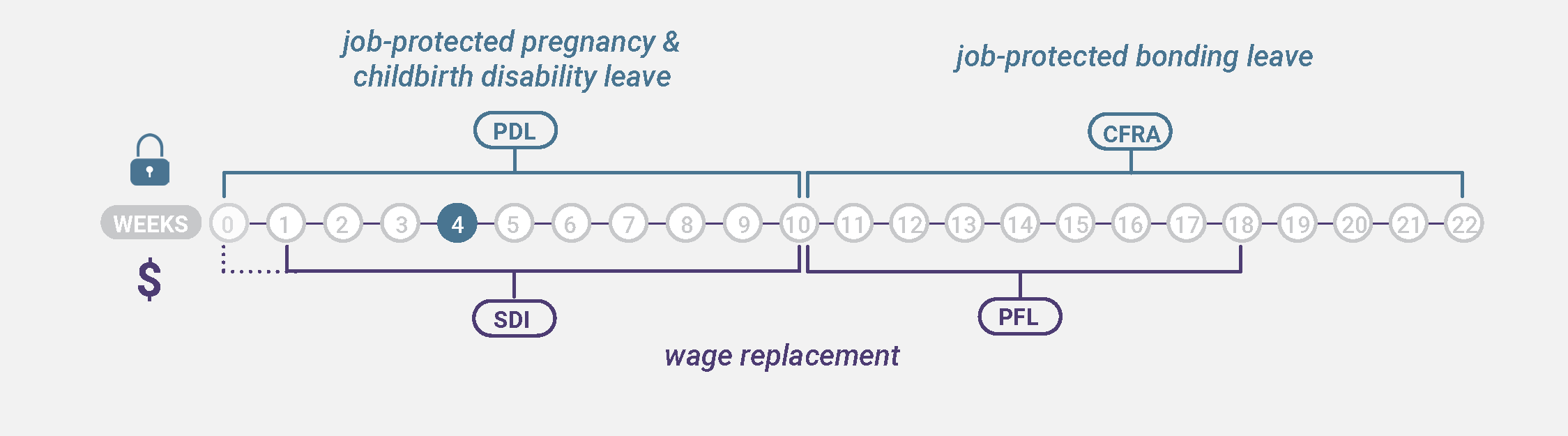
Ada has a typical pregnancy and an uncomplicated vaginal delivery. She takes leave 4 weeks before her baby is born through PDL, 6 weeks to recover after the birth through PDL, and 12 weeks to bond with her baby through CFRA. She is paid through SDI for 9 weeks (after a 1-week unpaid waiting period) and PFL for 8 weeks once she starts bonding.


Complicated Pregnancy

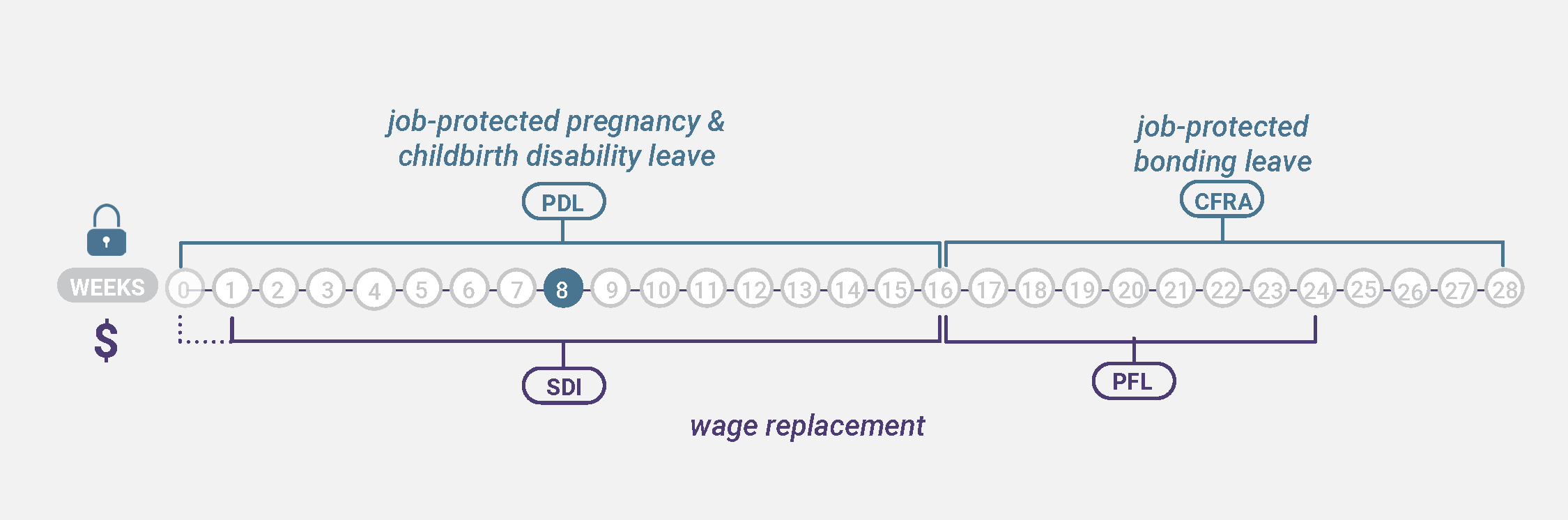
Leona’s doctor puts her on bedrest 8 weeks before her due date and she has a C-section. She takes leave for 8 weeks before her baby is born through PDL, 8 weeks to recover from her C-section through PDL, and then 12 weeks to bond through CFRA. She is paid through SDI for 15 weeks (after a 1-week unpaid waiting period) and PFL for 8 weeks once she starts bonding.


Sample Timelines: Premature Birth and Complications

Premature Birth and Health Complications

Pregnant Parent: Graciela’s baby is born 8 weeks premature while she is still working. Graciela is very stressed. Her doctor diagnoses her with postpartum depression. Graciela ends up needing 6 months off work for her health. To protect her job, she uses her 4 months of PDL. She still needs another 2 months of leave to recover, so she requests to use her CFRA leave for her own health for 9 weeks. Graciela is paid by SDI for the whole 6 months (after a 1-week unpaid waiting period). Because Graciela used 9 of her 12 weeks of CFRA leave for her own health, she only has 3 weeks of job-protected time off to bond with her baby after she has recovered. If she takes time off to bond, she can receive income through PFL for 8 weeks, but after the first 3 weeks, her employer will not be required to keep her job for her.
 

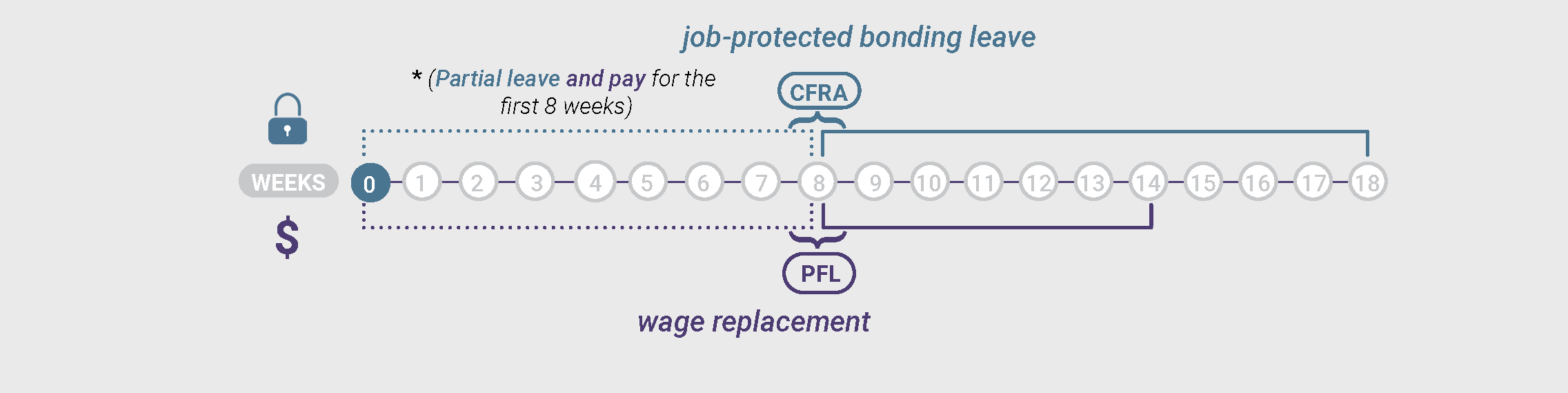
Other Parent: DeMarcus’s daughter is born 8 weeks premature and placed in the NICU. DeMarcus requests two hours off per day to help care for her. When his baby leaves the NICU 8 weeks later, he has already used up 2 full weeks of CFRA leave (80 hours), so he takes an additional 10 full weeks of leave to care for her. He receives pay from PFL for 8 weeks.


Other Family Member: Nina’s grandson is born with serious health complications. When her grandson’s parents have to go back to work, Nina takes 12 weeks of CFRA leave from her work to help care for him. She is paid by PFL for 8 weeks.


Questions? Call the Work & Family Helpline at 800-880-8047


This content was created by Legal Aid at Work in partnership with California Perinatal Quality Care Collaborative (CPQCC). Copyright January 2023. LegalAidatWork.org | CPQCC.org